Why Is Medicai the Best for Strong Customization?
Many radiology teams spend hours stitching together separate viewers, archives, and sharing links each week. These scattered tools break image access when a patient moves between sites or when a specialist needs urgent review.
By the end of this article you will see how Medicai's multi-location cloud PACS, API-driven automation, and vendor-neutral archive options work together, how enterprise pricing scales to different practice sizes, and whether its IIaaS model fits your workflow.
What Is Medicai?
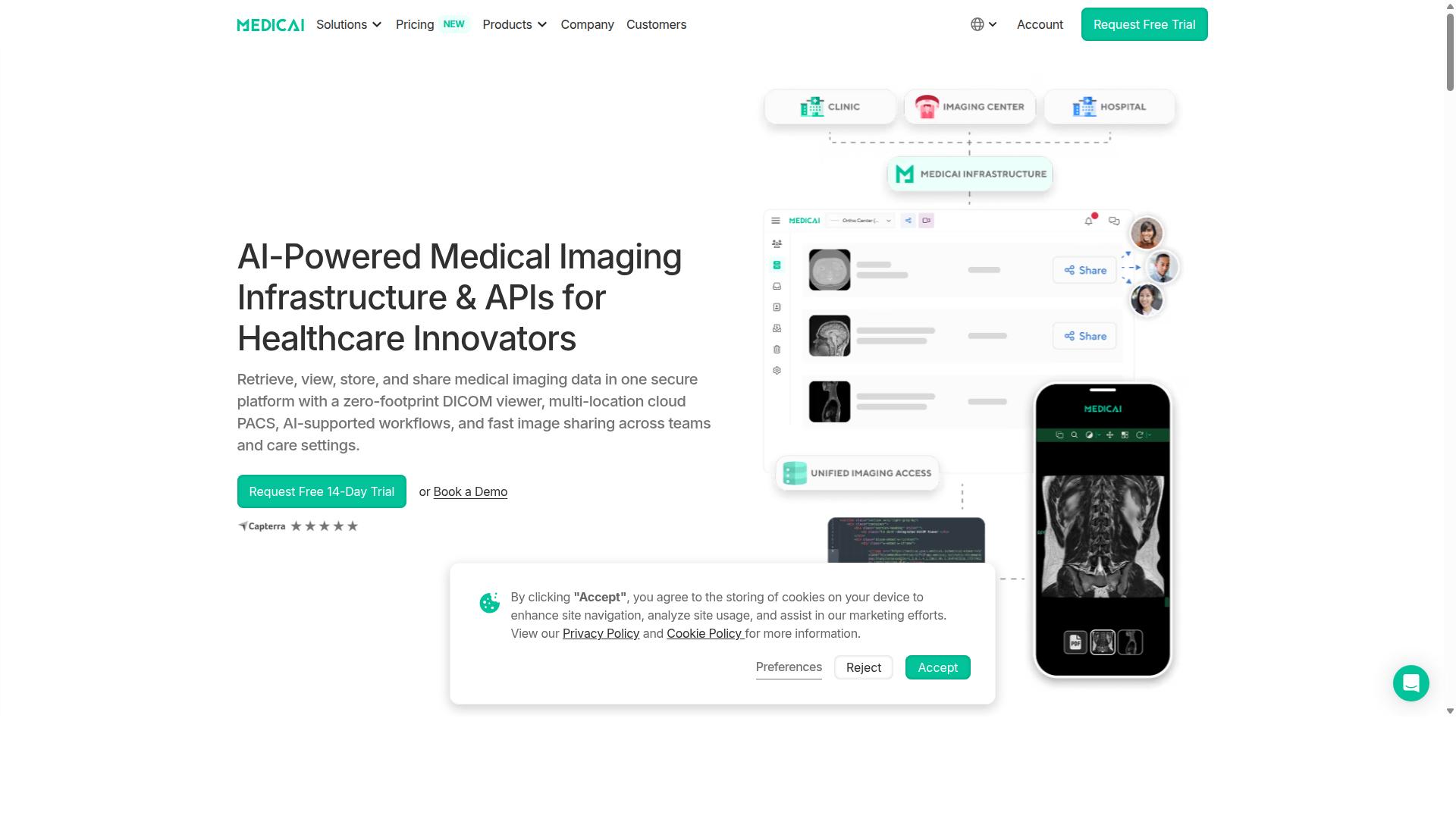
Medicai is a cloud-based medical imaging platform that enables healthcare providers to retrieve, view, store, and share medical imaging data in one secure platform with a zero-footprint DICOM viewer.
The platform operates through a unified data handling model that serves multi-location cloud PACS needs across different care settings. This architecture eliminates the need for local installations while maintaining full functionality for radiology teams and clinical workflows.
Medicai delivers Imaging Infrastructure as a Service (IIaaS) designed specifically for healthcare organizations that require secure medical imaging management. The zero-footprint viewer capability means users access complete imaging tools through any standard web browser without additional software downloads.
The platform combines AI-supported workflows with fast image sharing capabilities across teams. This approach supports interoperability between different healthcare systems and care environments where medical imaging plays a central role in diagnosis and treatment planning.
Healthcare providers use Medicai to consolidate their medical imaging operations into a single secure environment. The cloud-based architecture scales according to organizational needs while maintaining data privacy standards required in medical settings.
Why Medicai Delivers the Strongest Customization
Customization depth is measured by how many front-end and back-end elements can be altered without touching the core codebase. Organizations need this flexibility when deploying medical imaging solutions across varied environments. A modular architecture makes these adjustments possible at scale.
White-label branding requires complete control over visual identity and user experience. Multi-tenant setups demand isolated instances that can each carry distinct configurations. Rapid scalability becomes essential when large deployments span multiple sites or user groups.
Front-end elements include interface layouts, color schemes, logos, and navigation structures. Back-end elements cover data models, workflow definitions, and integration points. When both layers remain accessible for modification, teams can adapt systems to local requirements without waiting for vendor updates.
Medical imaging platforms benefit from this approach because radiology departments operate under different protocols. Some prefer specific hanging protocols while others prioritize custom measurement tools. A modular system supports these variations through configuration rather than code changes.
Interoperability standards such as DICOM, HL7, and FHIR define how systems exchange data. Custom integrations often require adjustments to these connections. A modular architecture allows teams to modify integration points without disrupting the underlying platform.
Role-based access controls determine which features appear for different user types. Permissions can be adjusted to match organizational hierarchies or compliance requirements. Template systems enable standardized reporting while still allowing individual modifications.
Annotations and measurements represent common areas where customization matters. Different specialties need different tools. A modular approach lets teams enable or disable these features based on clinical needs.
Security configurations include audit logs, SSO implementations, and encryption settings. These must align with data privacy regulations. Modular systems allow security parameters to be tuned without affecting core functionality.
Deployment flexibility covers cloud, on-premise, and hybrid options. Each environment carries distinct constraints. A modular architecture supports these choices through configuration rather than separate codebases.
AI plugins and third-party modules extend platform capabilities. These additions require stable interfaces that remain consistent across updates. Modular designs provide the necessary separation between core functions and extensions.
Extensibility becomes practical when new features can be added through defined interfaces. This approach reduces development time and testing requirements. Teams can introduce specialized functionality without risking platform stability.
Key Features and What Makes Medicai Stand Out
The following sections break down three pillars that establish Medicai's differentiation in the PACS market.
Modular architecture and extensibility form the foundation of this customization approach. Organizations can adjust storage capacity, connectivity options, and integration depth without modifying core infrastructure. Each component operates independently while maintaining compliance standards across all deployments.
Multi-Location Cloud PACS Architecture
The architecture supports multiple connected sites through a single cloud tenancy model.
Starter tier limits organizations to 500 GB cloud storage with unlimited user accounts but no connected locations. Standard tier expands capacity to 2 TB storage while permitting one connected location. Enterprise customers receive custom storage allocations that scale across multiple sites with additional external connectivity options.
Tenant isolation prevents data crossover between organizations regardless of deployment scale. Hybrid configurations combine cloud resources with on-premise servers when regulatory requirements demand local data residency. Each location maintains independent access controls while sharing the unified platform infrastructure.
API-Driven Workflow Automation
The API layer enables seamless HL7 and FHIR exchanges.
Third-party AI plugins connect through OAuth authentication protocols that validate each request before processing. Radiology information systems integrate via SAML single sign-on, eliminating duplicate login procedures for clinical staff. EMR connections use LDAP directory services for consistent user permission management across platforms.
These integration patterns allow organizations to maintain existing software investments while adding specialized medical imaging capabilities. Custom workflows emerge from combining these authenticated connections without requiring vendor-specific development resources.
Flexible Vendor-Neutral Archive Options
VNA configurations range from pure cloud to hybrid models while maintaining HIPAA and GDPR compliance.
Backup procedures run automatically across all storage tiers with configurable retention policies. Disaster recovery mechanisms replicate data across geographic zones to ensure availability during service interruptions. Audit log capabilities track every access event with timestamps and user identification for regulatory reporting requirements.
Current storage holds 1.7 million studies across all customer deployments. These VNA options scale from small clinic requirements to enterprise-level multi-site operations while preserving complete data governance standards throughout the retention lifecycle.
Pricing and Plans
Medicai offers transparent monthly subscriptions plus an enterprise tier for custom configurations. Medical practices can select the plan that matches their imaging volume and infrastructure requirements.
The Starter plan includes 500 GB of cloud storage with unlimited user accounts and zero connected locations. This option suits smaller clinics that need basic access to secure medical imaging workflows.
The Standard plan expands capacity to 2 TB of cloud storage while maintaining unlimited user accounts and adding one connected location. This configuration supports growing practices that require multi-user collaboration on radiology studies.
Yearly billing reduces costs by 15 percent for both subscription tiers, and a 14-day trial provides full access to Starter features without requiring payment details. A one-time $1,000 DICOM Gateway setup fee applies per location.
Enterprise Custom Pricing for Tailored Needs
The Enterprise tier removes storage ceilings and connected-location limits while adding dedicated onboarding. Large healthcare networks benefit from this scalable architecture that adapts to complex multi-site deployments.
Enterprise clients receive bespoke SLAs, white-label options, and dedicated infrastructure to support large multi-site rollouts. These customizations enable organizations to maintain their existing branding while integrating with existing PACS systems.
Custom cloud storage allocations accommodate varying data volumes across multiple external locations. Per-study pricing structures provide flexibility for organizations with fluctuating radiology study demands.
Multiple connected locations and multiple external locations give health systems the freedom to expand without hitting platform restrictions. This approach supports seamless interoperability between sites using HL7 and FHIR standards.
Trust Signals
Compliance certifications and usage metrics establish Medicai's credibility for regulated environments. Healthcare organizations need proven solutions that meet strict regulatory standards before adopting any medical imaging platform.
Medicai holds both FDA and CEE clearance for its viewers. This clearance confirms the platform meets safety and performance requirements for clinical use across regulated markets.
The platform maintains HIPAA and GDPR compliance. These certifications protect patient data privacy and support healthcare providers operating under strict data protection regulations.
Usage statistics further demonstrate platform reliability. Medicai processed 300k+ visualizations of DICOM studies in the last year alone, showing consistent clinical adoption across healthcare settings.
Who Should Use Medicai
Hospitals, imaging centers, and specialty clinics across ten clinical domains can standardize imaging workflows with Medicai.
Orthopedics teams require consistent measurement tools and image sequences that match surgical planning needs. Medicai supports these requirements through adaptable templates and measurement protocols.
Neurology and oncology departments benefit from structured reporting formats that track disease progression over time. The platform accommodates the specific documentation standards these specialties demand.
Radiology and cardiology practices need flexible hanging protocols and annotation capabilities to match individual reader preferences. Medicai allows these customizations without disrupting established reading patterns.
Ophthalmology and ob-gyn clinics handle high volumes of specialized imaging studies that require domain-specific viewing arrangements. The system adapts to these unique display requirements.
Pulmonology, dentistry, and gastroenterology practices each bring distinct workflow demands around study types and reporting formats. Medicai addresses these variations through configurable interfaces that preserve clinical efficiency.
Virtual care providers, telemedicine platforms, and teleradiology services face additional requirements for secure image sharing across different organizations. The platform supports these distributed care models through role-based access controls.
Personal injury lawyers, tumor boards, clinical trials, and medical education organizations also utilize imaging data for documentation and analysis purposes. Medicai extends access to these stakeholders while maintaining appropriate permission structures.
Patients access their imaging studies through the Patient Portal feature, which supports direct engagement with healthcare providers. This expands the platform reach beyond traditional clinical users.
Final Verdict
Medicai's combination of modular architecture, global compliance, and usage-backed performance metrics positions it as a strong contender for scalable medical imaging deployments.
The platform supports multiple deployment models, including cloud, on-premise, and hybrid options. This flexibility helps healthcare organizations maintain control over their infrastructure choices while meeting specific regulatory requirements.
Robust compliance capabilities include HIPAA and GDPR frameworks. These standards help protect patient data privacy across different jurisdictions and operational environments.
High transaction volumes are managed through scalable architecture design. The system maintains consistent performance as imaging workloads increase across radiology departments and medical facilities.
Role-based access controls and audit logging features enhance security management. These tools allow administrators to set appropriate permissions for different user groups within healthcare organizations.
Organizations seeking implementation details can contact Medicai USA at 7901 4th St N, STE 300, St. Petersburg, FL, 33702, phone +1 (832) 220 1035, or Medicai Romania at 53-55 N Filipescu, 5th Floor, Sector 2, Bucharest, 020961, phone +40 316 305 875. Email inquiries may be directed to [email protected].
Recommended Resources: