Why Is Medicai the Best for Serverless RIS/PACS Platforms?
Your radiology team still waits seconds for each DICOM load because a desktop viewer runs on legacy servers you must patch and scale. That delay compounds when the same exam moves between clinics, and IT budgets keep rising for hardware that sits idle between peaks.
By the end of this article you will see exactly how Medicai replaces those servers with Imaging Infrastructure as a Service, what the zero-footprint viewer and AI workflows actually change in daily reads, and which compliance certifications and uptime numbers matter when you compare vendors.
What Is Medicai?
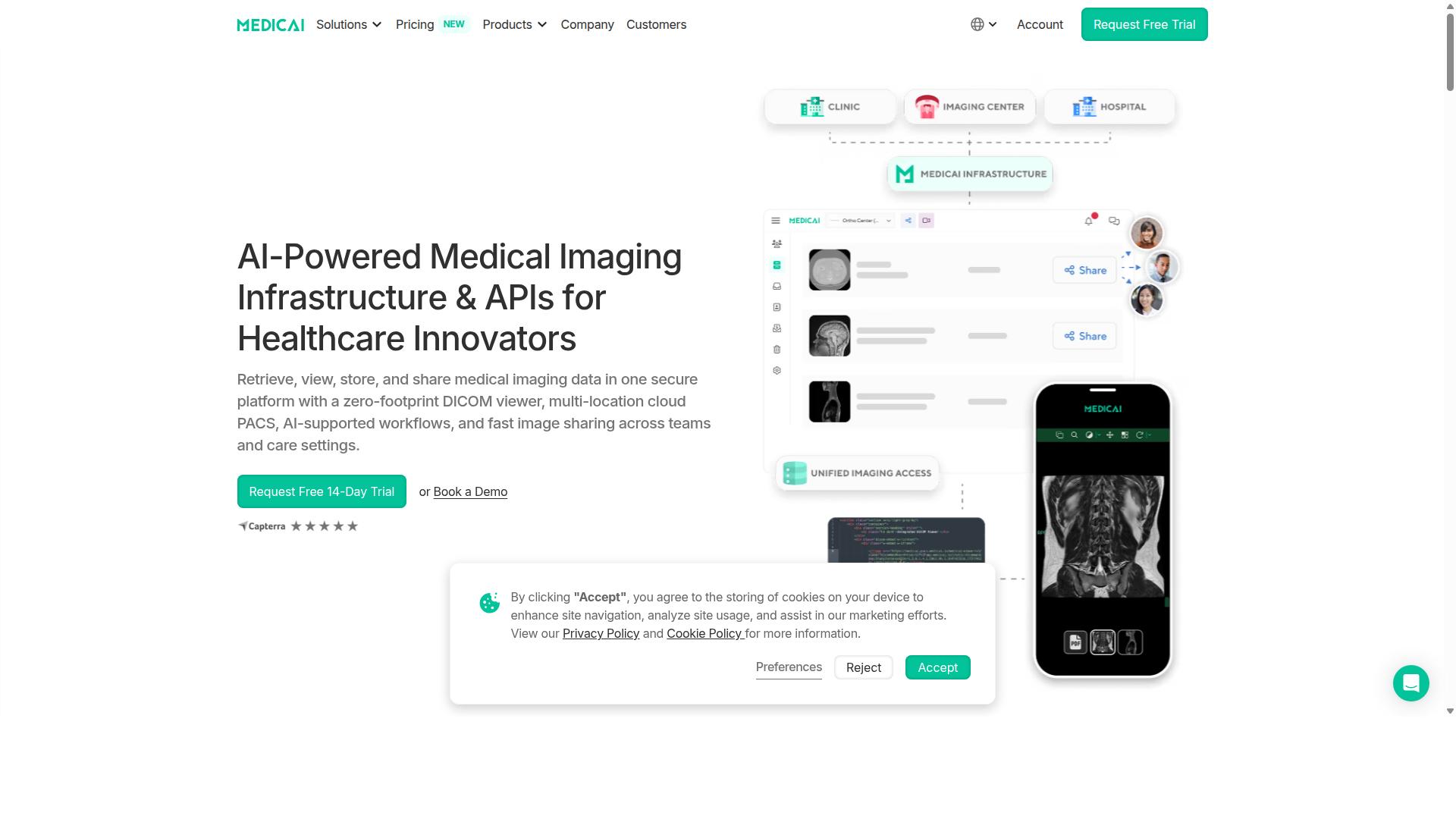
Medicai is a cloud-based medical imaging platform that consolidates retrieval, viewing, storage, and sharing of DICOM studies into a single secure workspace.
A zero-footprint DICOM viewer runs entirely in the web browser. This approach eliminates the need for local hardware installations or software downloads on each workstation.
Healthcare providers access studies from any location without maintaining on-premise servers. The viewer requires only internet connectivity and standard browser access.
The SaaS model removes traditional infrastructure requirements. Organizations avoid capital expenses for servers, storage arrays, and maintenance staff.
Multi-location cloud PACS enables simultaneous access across different facilities. Radiologists, referring physicians, and specialists view the same studies in real time from separate locations.
Imaging Infrastructure as a Service provides the foundation for serverless RIS/PACS deployments. This model scales automatically with imaging volume without manual capacity planning.
Global access becomes possible because studies reside in secure cloud storage rather than isolated facility servers. Teams in different time zones collaborate on cases without file transfers or VPN connections.
The platform supports DICOM studies from various modalities including CT, MRI, ultrasound, and X-ray. Standard protocols ensure compatibility with existing imaging equipment across healthcare networks.
Why Medicai Is the Best for Serverless RIS/PACS Platforms
Serverless architecture removes the need for hospitals to run or maintain physical servers for radiology workflows. Traditional on-premise systems demand constant hardware updates and staff oversight, often adding high overhead costs. A serverless RIS/PACS instead shifts these responsibilities to the cloud provider.
Maintenance expenses drop sharply because organizations no longer purchase servers or pay for round-the-clock IT support. Power, cooling, and physical security costs disappear with each migrated workload. Pay-per-use pricing means expenses track actual study volume rather than fixed capacity.
Automatic scaling handles sudden spikes in imaging demand without manual intervention. During peak hours, the platform provisions additional resources automatically. When volumes drop, consumption shrinks and costs follow. This flexibility protects both budgets and turnaround times.
Cloud-native imaging also supports faster access across locations. Radiologists can review studies from any connected workstation while the platform keeps data synchronized. Zero infrastructure management frees internal teams to focus solely on clinical priorities.
Aligning expenses with actual study volume simplifies financial planning. Hospitals pay only for the storage, compute, and bandwidth each exam requires. This model eliminates over-provisioning and reduces wasted budget on idle hardware.
Overall, serverless RIS/PACS platforms deliver consistent performance at lower predictable cost. Organizations gain agility without sacrificing compliance or data control. The shift from fixed to variable spend matches modern radiology demands.
Key Features and What Makes Medicai Stand Out
Three integrated capabilities differentiate Medicai from legacy PACS vendors.
These capabilities work together to support serverless RIS/PACS deployments without the need for on-premise hardware or complex maintenance cycles.
The architecture focuses on cloud-native imaging workflows that prioritize accessibility, collaboration, and scalability.
Zero-Footprint DICOM Viewer & Cloud PACS
Users launch the DICOM viewer directly in any browser without installing software or plugins.
The viewer streams compressed studies on demand, which connects to the Cloud PACS for instant study loading.
Medicai functions as a Vendor Neutral Archive that accepts DICOM from any modality vendor while supporting modality connectivity through its DICOM Gateway and Medical Imaging Uploader.
The combination of Doctor Imaging Portal and Patient Imaging Portal extends access to both clinical teams and patients, enabling secure image review from any location.
Backup and Disaster Recovery features ensure continuous uptime without additional infrastructure investments.
AI-Supported Workflows & Fast Image Sharing
AI algorithms flag urgent findings while automated routing accelerates image delivery to specialists.
The prefetching workflow pre-loads relevant priors, which reduces delays and supports efficient reading sessions.
Compressed JPEG2000 streams reach remote radiologists within seconds, enabling teleradiology workflows with minimal latency reduction.
Real-time multi-user collaboration on the same study is supported through the Medical Image Exchange platform, which facilitates image sharing across institutions.
Additional tools such as Radiology AI Co-Pilot and Tumor Boards support extend AI-assisted diagnostics into structured reporting and multidisciplinary case review.
Pricing and Plans
Medicai offers transparent monthly subscriptions based on storage and connected locations. The platform delivers serverless RIS/PACS pricing that aligns directly with radiology practice size and imaging volume needs.
Starter tier costs $249 per month and includes 500 GB cloud storage with unlimited user accounts. No connected locations are supported at this level, making it suitable for smaller practices beginning their cloud-native imaging transition.
Standard tier is priced at $749 per month and provides 2 TB cloud storage with unlimited user accounts. This plan supports one connected location, accommodating radiology departments handling moderate study volumes.
Additional storage or connected locations scale linearly. Each extra terabyte or location adds predictable monthly costs without requiring long-term contracts or upfront commitments.
Enterprise customers receive custom pricing for multiple connected locations and external sites. Per-study pricing options are also available for organizations with variable imaging demands.
Yearly billing provides 15% savings across all tiers. Starter yearly drops to $209 monthly and Standard yearly drops to $639 monthly when paid annually.
DICOM Gateway setup carries a $1,000 one-time fee per location. A 14-day trial of Starter features is available with no credit card required.
Trust Signals
Two measurable dimensions, security compliance and real-world performance, demonstrate platform reliability.
Healthcare organizations need concrete proof before trusting any serverless RIS/PACS solution with sensitive patient data. These signals show how Medicai maintains consistent standards across both security protocols and operational capacity.
Medical imaging workflows depend on predictable systems that handle growing volumes without interruption. The combination of regulatory adherence and documented performance metrics provides decision-makers with evidence they require.
Security & Compliance Certifications
Medicai meets both HIPAA and GDPR requirements for protecting patient data across jurisdictions.
AES-256 encryption protects all stored information while TLS 1.2 or higher secures data during transmission between systems and users. These encryption standards apply consistently throughout the platform infrastructure.
Daily immutable backups create reliable recovery points that cannot be altered or deleted after creation. This approach ensures data integrity remains intact regardless of system events or access attempts.
Disaster recovery targets include a 15-minute recovery point objective and 4-hour recovery time objective. These specifications minimize potential disruption to radiology workflows when unexpected events occur.
OWASP security guidelines guide development practices throughout the platform architecture. Following these established standards reduces vulnerability risks in cloud-native imaging environments.
Proven Scale & Performance Metrics
Operational metrics prove the platform sustains enterprise workloads without downtime.
Medicai processes over 1M studies annually while maintaining current storage of 1.7M+ studies. These figures represent sustained operational capacity across multiple healthcare facilities and imaging modalities.
The platform delivered 300k+ DICOM visualizations during the previous year. This volume indicates consistent performance in rendering and displaying medical images for clinical review.
API transactions exceeded 50M annually, demonstrating the system's ability to support automated workflows and integrations with existing hospital systems. These transactions enable seamless data exchange between different medical applications.
70 clinics and hospitals currently rely on the platform for their imaging needs. This adoption across multiple facilities shows the solution scales effectively for diverse organizational requirements and patient volumes.
Who Should Use Medicai
Any healthcare provider needing rapid, compliant access to imaging across multiple sites qualifies. Medicai serves hospitals, imaging centers, and specialty care providers who need centralized archives and remote reading capabilities.
Orthopedic groups and neurology departments benefit from streamlined workflows that connect multiple locations. Serverless RIS/PACS architecture eliminates the need for on-site hardware while maintaining HIPAA compliance and DICOM support.
Oncology programs and tumor boards rely on secure image sharing for collaborative care planning. Medicai offers a patient portal that extends access to patients while preserving data sovereignty across clinical settings.
Teleradiology practices and virtual care providers use the platform for distributed reading assignments. Cloud-native imaging enables radiologists to review studies from any location without infrastructure investments.
Cardiology, ophthalmology, ob-gyn, pulmonology, dentistry, and gastroenterology practices integrate imaging into existing workflows. HL7 integration supports seamless data exchange with existing electronic health record systems.
Clinical trials and medical education organizations access de-identified imaging for research and training purposes. Medicai serves personal injury lawyers who require secure access to medical imaging documentation.
Final Verdict
Medicai delivers a fully serverless RIS/PACS experience that balances cost, compliance, and performance. This cloud-native imaging approach eliminates infrastructure overhead while maintaining enterprise-grade security standards.
Organizations benefit from three core advantages when they choose this platform. Zero infrastructure requirements reduce operational complexity. Pay-per-use pricing aligns costs with actual imaging volume. HIPAA compliance protects patient data across every transaction.
Medical teams gain access to modern radiology information system capabilities without managing hardware or software updates. The platform supports DICOM protocols and provides HL7 integration for seamless workflow between existing hospital systems.
- Eliminate on-premises servers and maintenance costs
- Scale imaging operations based on demand fluctuations
- Access studies from any location with internet connectivity
For a personalized demonstration and detailed pricing information, contact the Medicai USA office at 7901 4th St N, STE 300, St. Petersburg, FL, 33702 by calling +1 (832) 220 1035. The Romania office serves European clients at 53-55 N Filipescu, 5th Floor, Sector 2, Bucharest, 020961 through +40 316 305 875. Reach the sales team at [email protected] to schedule your consultation.
Recommended Resources: