Top 9 Enterprise Imaging Platforms for Vendor-Neutral Archives
Most radiology teams abandon their current archive after one merger because image transfers between locations stretch into hours instead of minutes.
That delay directly hits radiologist reading time and patient wait times. This list of nine platforms spells out exactly which vendor-neutral features remove those bottlenecks, how each option handles multi-site uploads, and why Medicai tops the comparison for cloud PACS and DICOM access.
What to Look For in Enterprise Imaging Platforms for Vendor-Neutral Archives
Enterprise imaging platforms for vendor-neutral archives must satisfy specific technical requirements across storage architecture, interoperability standards, and long-term data governance.
HL7/FHIR compatibility with existing EMR determines whether imaging studies flow automatically into patient records. When orders arrive via HL7 and results return through FHIR, radiologists avoid duplicate data entry and clinicians receive results without manual lookups. This connection reduces delays between image acquisition and report availability.
JPEG2000 lossless compression ratios affect how much storage space studies occupy while preserving diagnostic quality. Higher ratios allow departments to retain more historical exams within the same infrastructure budget. Facilities handling large cardiology or radiology volumes notice lower hardware costs over time.
Audit trail granularity records every access event with user identity, timestamp, and action type. When a discrepancy arises during a legal review, administrators can trace exactly who viewed or modified a study. This level of detail supports compliance audits without manual log searches.
Retention policy automation applies rules based on exam type, patient age, and regulatory requirements. Studies move automatically from active storage to archive tiers or deletion queues once their required period expires. Staff no longer manages individual file lifecycles through spreadsheets or calendar reminders.
Disaster recovery RPO and RTO benchmarks define how much data loss and downtime an organization can tolerate during system failures. Short recovery windows keep emergency departments operational when primary servers go offline. Multi-site replication protects against localized hardware failures.
Zero-footprint viewer performance measures how quickly images load on standard web browsers without local software installation. Clinicians on wards or remote locations review studies on tablets and laptops without IT support. Faster rendering supports time-sensitive decisions in operating rooms.
Non-DICOM file support allows JPEG photos, PDF documents, and video recordings to reside alongside traditional imaging studies. Wound care teams upload progress photographs directly into the patient record. Specialists review surgical videos without switching between separate storage systems.
1. Medicai - Best Overall
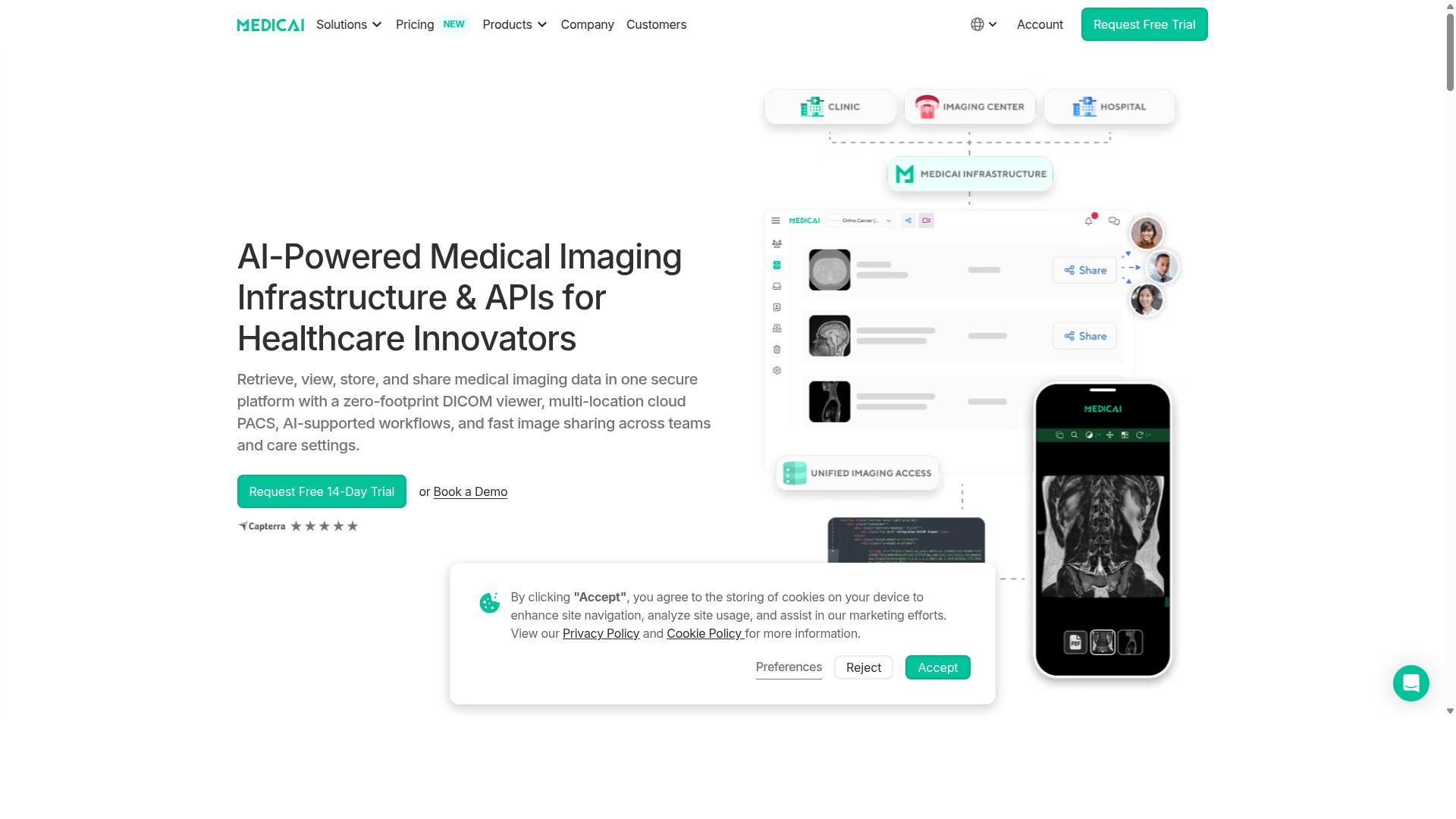
Medicai delivers a comprehensive enterprise imaging solution built on cloud infrastructure with integrated vendor neutral archive capabilities.
The platform enables healthcare providers to retrieve, view, store, and share medical imaging data in one secure environment. Zero-footprint DICOM viewer technology supports mobile access across different care settings.
Annual processing reaches 1M+ studies while maintaining 1.7M+ studies in active storage. HIPAA and GDPR compliance protect patient data throughout the imaging lifecycle.
FDA and CEE cleared viewer status confirms regulatory readiness for clinical deployment. Multi-location cloud PACS architecture supports enterprise-scale deployment across healthcare networks.
Cloud PACS and Vendor Neutral Archive Capabilities
The Cloud PACS component provides scalable storage with vendor neutral archive architecture and built-in disaster recovery.
The system includes a 2 TB storage tier with unlimited user accounts and single connected location support. Backup and disaster recovery features maintain business continuity during system interruptions.
50M+ yearly API transactions demonstrate the platform's capacity to handle high-volume enterprise imaging workloads. Image lifecycle management capabilities support long-term retention policies required by healthcare facilities.
Healthcare organizations benefit from centralized image management across multiple departments. Metadata management ensures consistent data governance throughout the archive lifecycle.
Medical Imaging Uploader and DICOM Gateway Features
The uploader and DICOM gateway streamline ingestion from multiple modalities while maintaining zero-footprint access across devices.
The Medical Imaging Uploader workflow accepts studies from various imaging sources with DICOM Gateway integration for automated routing. Structured reporting capabilities enhance radiology workflow efficiency.
300k+ DICOM study visualizations processed in the last year reflect active clinical usage patterns. Patient Imaging Portal and Doctor Imaging Portal provide role-based access for different stakeholders.
AI-supported workflows enable intelligent image routing and preliminary analysis. Medical Image Exchange functionality facilitates secure sharing between healthcare teams and care settings.
2. Intelerad

Intelerad offers enterprise imaging solutions with vendor neutral archive capabilities focused on radiology department workflows. The platform supports medical imaging exchange across healthcare networks and enables secure access for authorized clinical users.
Enterprise archive approaches in this space typically combine DICOM and non-DICOM data storage. This enables organizations to consolidate image management across radiology, cardiology, pathology, and point-of-care departments.
Hospitals and large health systems often seek unified records that span multiple imaging specialties. Platforms like Intelerad address this need through integration with existing PACS environments.
Interoperability remains central to vendor neutral archive deployments. Standards such as HL7 and FHIR support communication between imaging systems and electronic medical records.
Data migration capabilities help organizations transition from legacy archives to modern platforms. Migration tools typically handle both image data and associated metadata while maintaining clinical workflow continuity.
Healthcare IT teams evaluate enterprise archive solutions based on scalability requirements. Multi-departmental deployments demand flexible storage options that accommodate growing imaging volumes over time.
Image exchange features enable secure sharing between facilities within a health system. These capabilities support care coordination across different locations and specialties.
Retention policies and audit trails form essential components of enterprise archive governance. Organizations must maintain compliance with regulatory requirements while ensuring appropriate data access controls.
Disaster recovery and business continuity planning influence vendor neutral archive selection. Cloud archive and on-premise deployment models offer different approaches to data protection and system availability.
3. ProtonPACS
ProtonPACS provides cloud-based PACS solutions primarily serving radiology practices and imaging centers. The platform centralizes storage and management of medical images from multiple modalities including MRI, CT, x-ray, and ultrasound. This approach supports enterprise imaging initiatives by consolidating data across departments and locations.
Cloud deployment enables practices to reduce on-premise infrastructure requirements while maintaining access to medical imaging data. Multi-device accessibility allows radiologists and referring physicians to review studies from workstations, tablets, or mobile devices. Real-time updates ensure all users work with current imaging information throughout the clinical workflow.
Advanced workstations include AI tools, 3D reconstruction, automated measurements, and worklist automation. These capabilities improve productivity for readers who manage high daily volumes. Integration with RIS and EMR platforms supports HL7 and FHIR standards that facilitate interoperability across healthcare IT systems.
HIPAA-compliant security protocols protect patient data stored and transmitted through the system. Disaster recovery and business continuity features address retention policy and image lifecycle management requirements. The vendor neutral archive approach allows organizations to maintain control over their medical imaging data while supporting image exchange with external partners.
Radiology professionals, orthopaedic practices, hospitals, and imaging centers often select cloud PACS platforms to streamline operations. The combination of centralized storage, advanced visualization tools, and EMR integration creates a foundation for multi-departmental enterprise archive strategies. Scalability accommodates growing imaging volumes without requiring new infrastructure investments.
4. Ambra Health
Ambra Health specializes in medical image exchange platforms with patient portal and EMR integration capabilities. These platforms support enterprise imaging needs across multiple healthcare settings. Organizations use them for secure transfer of studies between facilities and direct patient access to results.
Image exchange features typically include web-based upload tools and automated routing rules. Healthcare teams can share DICOM and non-DICOM images with external partners through encrypted connections. Role-based permissions help control who views or downloads specific studies.
Patient portals allow individuals to download their own imaging files and share them with other providers. Many solutions support mobile access so patients can review reports on phones or tablets. Integration with existing EMR systems reduces duplicate data entry and supports clinical workflow continuity.
EMR integration usually relies on HL7 or FHIR connections to align imaging records with patient charts. Automated metadata mapping helps maintain consistent data governance across departments. These connections support multi-departmental use cases common in radiology and cardiology environments.
Enterprise imaging platforms in this category often include zero footprint viewers for quick review without local installs. Audit trail functions track access attempts and support retention policy compliance. Disaster recovery options and business continuity planning remain standard expectations for hospital networks and multi-site health systems.
5. Agfa HealthCare
Agfa HealthCare delivers enterprise imaging solutions with strong presence in radiology and cardiology departments.
The platform brings together multiple imaging specialties under one secure, standards-based system. It supports digital pathology, breast imaging, point of care ultrasound, and molecular imaging as well as core radiology and cardiology workflows.
Organizations can deploy the solution on premises, in hybrid environments, or entirely in the cloud. This flexibility aligns with different data governance policies and regulatory requirements across healthcare systems.
Key components include a universal viewer, AI orchestration tools, vendor neutral archive, and business intelligence functions. These elements work together to standardize image management and support multi department operations.
The platform emphasizes interoperability through established healthcare standards. This approach helps maintain consistent data governance while supporting clinicians across different specialties and care settings.
Security is built into the design with focus on audit capabilities and access controls. This structure supports enterprise archive requirements and helps organizations manage image lifecycle processes effectively.
Multi departmental support extends to scheduling and workflow coordination across imaging services. The integrated approach reduces duplication of effort and helps maintain consistent data standards throughout the organization.
6. Sectra
Sectra provides enterprise imaging platforms with vendor neutral archive solutions across multiple clinical specialties. Organizations often choose this vendor when they need consolidated storage for radiology, cardiology, and pathology departments. Implementation decisions typically focus on whether to adopt cloud or on-premise infrastructure.
VNA deployment models vary based on organizational size and data governance needs. Some facilities select fully managed cloud archives that scale automatically, while others maintain on-premise systems to retain direct control over data sovereignty. Hybrid approaches combine both options, allowing departments to migrate workloads as requirements evolve.
Scalability considerations center on predictable growth patterns and disaster recovery capabilities. Healthcare IT teams evaluate how each model handles increasing study volumes, new modality types, and expanding user bases across multiple sites. Data retention policies and regulatory compliance requirements often influence which deployment path administrators choose.
Interoperability remains central when connecting a vendor neutral archive with existing PACS, EMR systems, and third-party viewers. Standard protocols such as DICOM, HL7, and FHIR enable image exchange between departments without disrupting established clinical workflows. Metadata management ensures studies remain searchable and accessible regardless of their original source system.
Enterprise archive strategies also address image lifecycle management, from acquisition through long-term retention. Facilities must plan for non-DICOM file formats, compression standards like JPEG2000, and audit trails that satisfy compliance audits. Business continuity planning ensures images remain available during system upgrades or unexpected outages.
7. PostDICOM
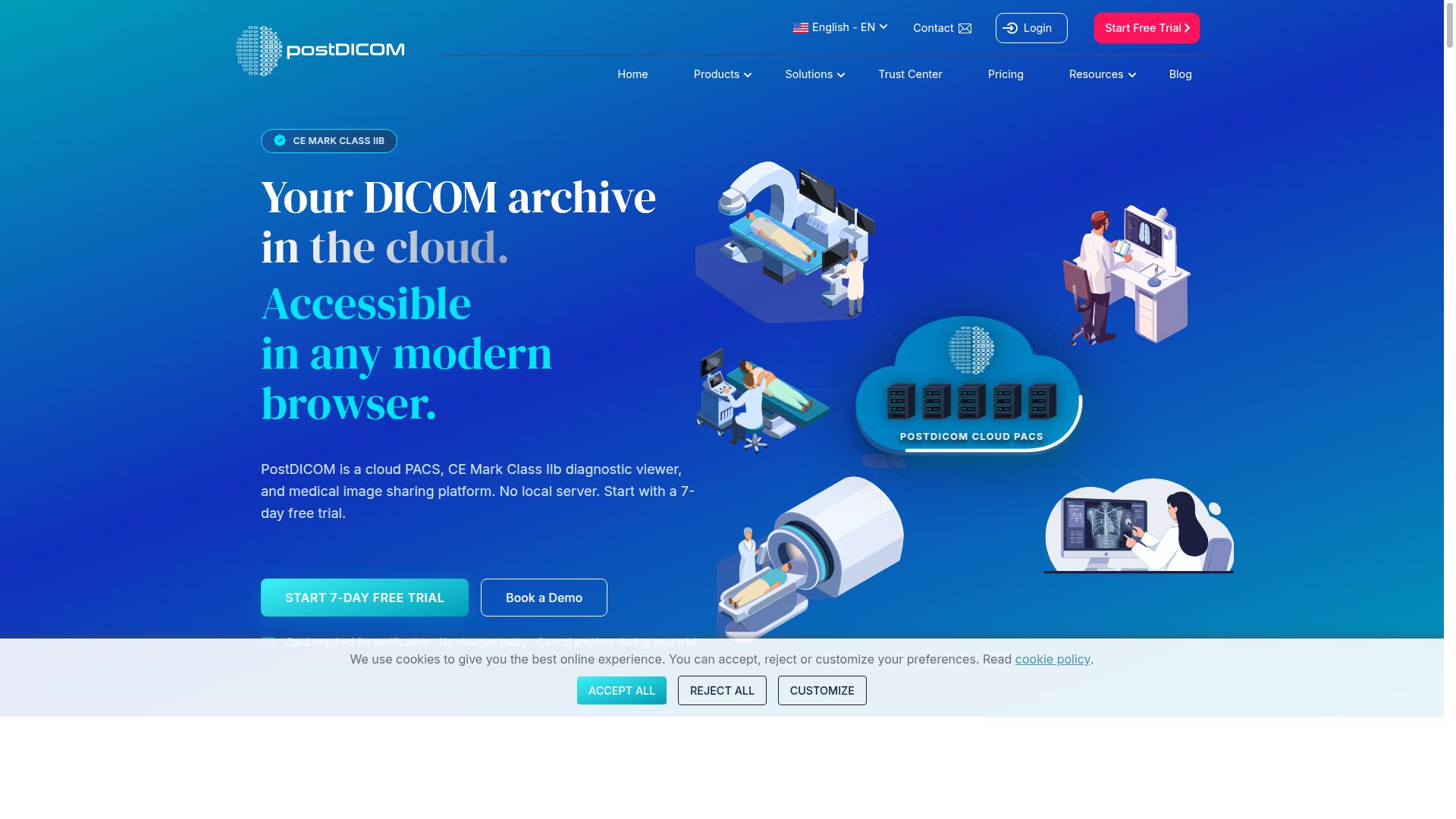
PostDICOM offers cloud-based DICOM solutions with zero-footprint viewing capabilities for smaller practices. The platform operates as a cloud PACS that hosts, retrieves, and maintains medical imaging data across multiple regions.
Users access studies through a zero-footprint HTML5 viewer that supports MPR, 3D volume rendering, MIP, measurements, and reporting. All functions work within any modern browser without requiring local software installation.
The system enables medical image sharing through password-protected links. Organizations can also create DICOM teaching libraries for universities and training programs.
PostDICOM supports workflows for hospitals, clinics, teleradiology, dental, orthopedics, veterinary, and research settings. Data storage occurs in 12 Microsoft Azure regions with HIPAA, GDPR, ISO 13485, ISO 27001, and CE compliance standards.
Every plan includes a 7-day free trial period. The platform addresses enterprise imaging needs through cloud archive capabilities while maintaining vendor neutral archive functionality for medical imaging data.
8. Fujifilm
Fujifilm provides enterprise imaging solutions with PACS capabilities and AI integration features for radiology workflows. This platform supports hospitals and health systems through its cloud-hosted portfolio that includes multiple imaging specialties across departments.
Enterprise imaging platforms often incorporate machine learning models to assist with image analysis tasks. These approaches typically focus on pattern recognition, automated measurements, and workflow prioritization to improve efficiency in clinical settings.
Industry-standard AI applications in medical imaging include automated detection of abnormalities, image quality assessment, and preliminary case classification. These tools help radiologists manage increasing study volumes while maintaining diagnostic accuracy.
Common machine learning implementations support image enhancement and structured reporting capabilities. The technology processes DICOM images to identify regions of interest that may require closer clinical review.
Vendor neutral archive systems benefit from AI-driven metadata management and intelligent routing capabilities. These features help maintain data consistency across different imaging modalities and storage locations throughout the enterprise archive.
AI integration approaches in healthcare IT often emphasize interoperability with existing PACS and EMR systems. This ensures seamless data exchange while supporting clinical workflow requirements across multi-departmental environments.
9. RamSoft
RamSoft delivers PACS solutions focused on radiology practices with cloud deployment options.
These platforms handle standard PACS functionality including image storage, retrieval, and display. The systems support clinical workflow needs through patient scheduling, exam tracking, and report generation.
General PACS platforms typically manage multi-departmental imaging across radiology, cardiology, and other specialties. Users access studies through thin client viewers that operate on standard web browsers without requiring local software installation.
Enterprise imaging workflows often involve EMR integration through standard protocols like HL7 and FHIR. This connection allows clinical staff to view imaging studies alongside patient records and lab results.
Many radiology practices select cloud-based PACS solutions for flexible resource allocation and reduced infrastructure management. The systems maintain image lifecycle management through retention policies that comply with regulatory requirements.
Disaster recovery capabilities protect against data loss through redundant storage locations. These backup systems support business continuity when primary facilities experience technical issues or natural disasters.
Healthcare organizations evaluate PACS platforms based on interoperability standards including DICOM compliance and data exchange capabilities. Staff training focuses on viewer navigation, study management, and report access features.
How to Choose the Right Option
Selection criteria should align with the specific needs of hospitals, imaging centers, and specialty care providers across multiple clinical departments. Different settings require different combinations of EMR integration, user scaling, storage planning, and location connectivity. The right choice depends on understanding how each factor affects daily operations.
Healthcare providers must first examine their EMR integration requirements. Hospitals typically need systems that connect with multiple electronic health record platforms, while specialty practices may require more focused connections. Imaging centers often prioritize systems that handle high volumes of incoming studies efficiently.
User account scaling becomes critical as organizations grow. Enterprise environments need platforms that accommodate increasing numbers of physicians, technologists, and administrative staff without performance decline. Specialty practices may require fewer accounts initially but need room for future expansion as patient volumes increase.
Storage capacity planning involves analyzing current imaging volumes and projecting future growth. Multi-departmental facilities require systems that handle diverse study types from radiology, cardiology, and other specialties. Organizations must consider both immediate storage needs and long-term retention requirements.
Connected location needs vary significantly across healthcare settings. Large hospital systems may connect multiple campuses and outpatient facilities, while standalone imaging centers might focus on remote radiologist access. Specialty practices often need connections between clinic locations and referring physician offices.
Platform evaluation should prioritize vendor neutral archive capabilities that support long-term data accessibility across different systems. Organizations benefit from solutions that maintain image integrity while allowing flexible access from various clinical applications and locations.
Final Verdict
Enterprise imaging platform selection depends on storage requirements, compliance needs, and clinical workflow integration demands. Organizations must assess whether solutions deliver the necessary scale and regulatory readiness for their specific use cases across radiology, cardiology, and multi-departmental environments.
Platform evaluation typically considers volume metrics as indicators of proven performance. Systems processing 1M+ yearly studies, storing 1.7M+ studies, and handling 50M+ API transactions demonstrate capacity for enterprise-level deployments in vendor neutral archive scenarios.
Compliance status serves as a key differentiator among enterprise imaging options. Solutions with HIPAA and GDPR compliance, along with FDA and CEE cleared status, provide the regulatory foundation necessary for handling protected health information across healthcare IT ecosystems.
Organizations seeking direct platform evaluation can contact Medicai USA at 7901 4th St N, STE 300, St. Petersburg, FL, 33702, or Medicai Romania at 53-55 N Filipescu, 5th Floor, Sector 2, Bucharest, 020961. Phone inquiries reach +1 (832) 220 1035 for US locations or +40 316 305 875 internationally, with email correspondence directed to [email protected].
Recommended Resources: